Validating Aerodynamic Concepts Through Additive Manufacturing
In aerodynamic development, simulation is only one part of the engineering process. While Computational Fluid Dynamics (CFD) provides valuable insight into airflow behaviour and aerodynamic performance, physical validation remains essential before final manufacturing decisions can be made.
Formula Student FEUP is the Formula Student team of the Faculty of Engineering of the University of Porto, where students design, manufacture and compete with a race car as part of the international Formula Student engineering competition.
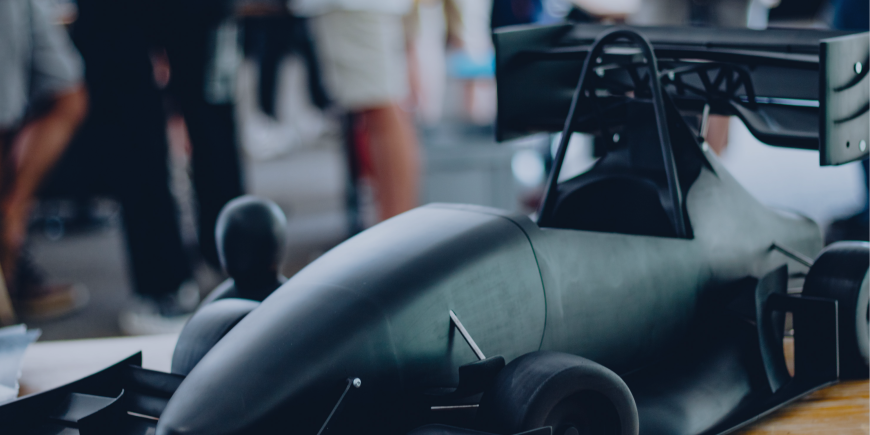
ACE supported Formula Student FEUP by manufacturing aerodynamic testing components through additive manufacturing, which were integrated into the wind tunnel models used during the validation process.
Manufacturing Components for Concept Testing
During the concept phase, the team required physical models capable of supporting wind tunnel testing of different aerodynamic configurations and validating CFD simulation results before final design decisions were made.
The manufactured components enabled the evaluation of different wing configurations and aerodynamic concepts under controlled test conditions.
Following concept evaluation, the project progressed into detailed design validation, requiring components that accurately represented the final aerodynamic package.
Producing the Final Validation Model
ACE produced several components through additive manufacturing to support both development phases. For concept validation, multiple configurations of front and rear wings were manufactured, together with wheel hub components used in the scale model.
For the detailed design phase, ACE produced the front wing for the final wind tunnel model, manufactured at a scale of approximately 1:3 relative to the final vehicle. Due to its geometry and aerodynamic requirements, the front wing represented the most complex component produced for the aerodynamic validation model. Following manufacturing, the components were integrated into the complete aerodynamic model used during wind tunnel validation.
Why Surface Quality Matters
For aerodynamic testing applications, manufacturing quality directly influences the reliability of the results. Even minor surface imperfections can disturb airflow, generate unwanted turbulence and affect measured aerodynamic performance. Similarly, dimensional deviations caused by warping, shrinkage or material deformation can reduce the correlation between simulation and experimental data.
For aerodynamic test models, manufacturing accuracy is essential to ensure that measured performance reflects the design itself rather than deviations introduced during production.
For this reason, two requirements were critical throughout the project:
Surface Quality
Aerodynamic surfaces must be manufactured with a high-quality finish to minimise disruptions to airflow and ensure representative test conditions.
Dimensional Stability
Components must accurately reproduce the intended CAD geometry while avoiding distortion, contraction or expansion during manufacturing. Meeting these requirements ensured that the wind tunnel measurements reflected the aerodynamic design itself rather than manufacturing deviations.
Additive manufacturing offers significant advantages when multiple design iterations and complex geometries are required.
By enabling the efficient production of highly detailed components, it supports development, testing and validation activities before final manufacturing begins.
For aerodynamic development projects, additive manufacturing enables the rapid production of scaled models, allowing design concepts to be evaluated and validated before committing to final manufacturing solutions.
The collaboration with Formula Student FEUP demonstrates how additive manufacturing can contribute to engineering projects where precision, repeatability and geometric accuracy are critical. Beyond the technical outcomes, collaborations such as this provide students with hands-on engineering experience while strengthening the connection between industry and academia.
Formula Student was possibly the most challenging engineering project of my life. The lack of experience, combined with the technical complexity of the project and demanding deadlines, helped me develop many of the engineering skills I still use today. That's why it is a great pleasure to work with my former team again and help provide the same opportunity I once received: gaining real engineering experience while still studying to become an engineer.
João Almeida, Mechanical Engineer (ACE Portugal)
The partnership between Formula Student FEUP and ACE enabled us to put additive manufacturing theory into practice and manufacture some of the most complex components of the aerodynamic package for FS FEUP 03. The high level of printing detail achieved allowed the team to obtain highly accurate results, validating the aerodynamic development tools created internally.
André Teixeira Pinto, Team Leader (FS FEUP)
NEED SUPPORT WITH ADDITIVE MANUFACTURING?
Discuss your design, manufacturing or industrialisation challenge with ACE engineers and determine whether additive manufacturing is the right solution for your application.